
Sourcing Cabinets for the Middle East Market
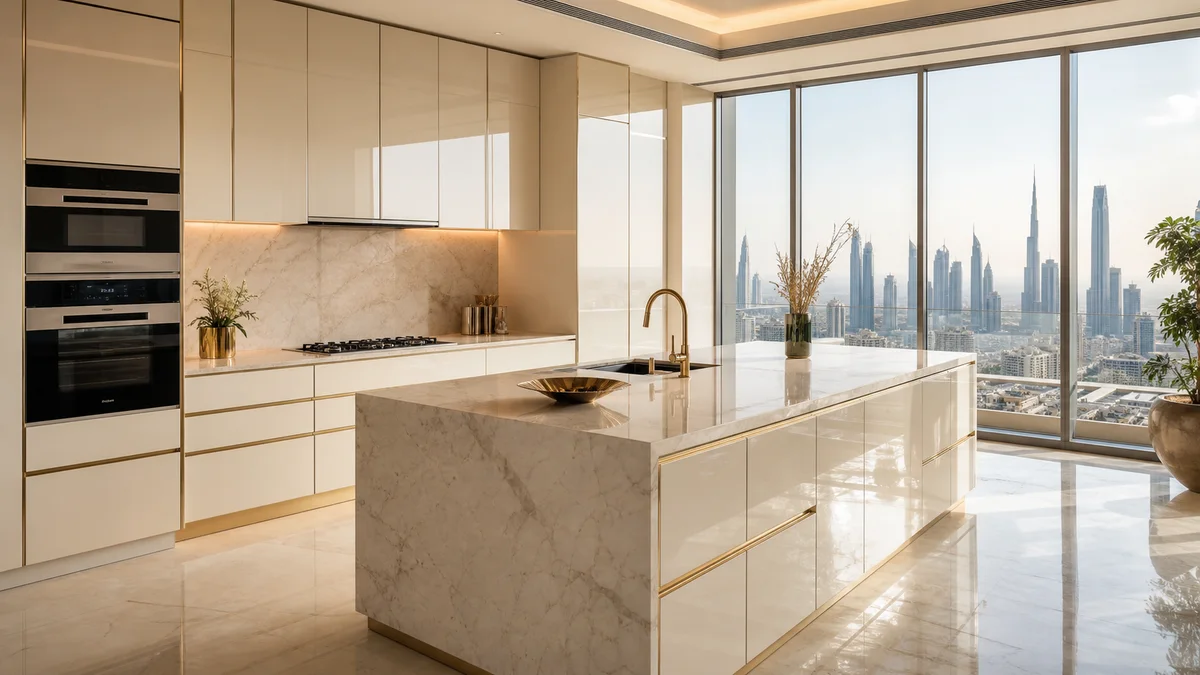
The Middle East is one of the world's most active cabinetry import markets — towers rising in the Gulf, villa compounds, hotel pipelines, and a construction culture comfortable with international procurement. It's also a market with its own taste, its own climate stresses and its own logistics rhythm. This guide covers what buyers in the GCC and wider region should know when sourcing cabinets from China — and how to get a specification that belongs in the region rather than merely shipped to it.
What the market likes: style preferences
Gulf projects skew unapologetically toward the premium look. High-gloss finishes remain strong — cream, white and warm neutrals with gold or brass accents in villas and classic projects — while the new-build apartment and hotel segment has moved decisively to handleless matte kitchens in the European idiom: greys, greige, warm woods, integrated appliances, clean lines. Larger homes frequently want both languages under one roof: a show kitchen in the entertaining space and a working "wet" kitchen behind it — a two-kitchen layout that's standard in the region and worth capturing in drawings from day one.
Two practical notes for specifiers. Kitchens in the region often double as status rooms, so visible sides, islands and tall banks deserve finished treatment everywhere sightlines reach. And walk-in wardrobes plus generous vanity programmes carry more weight in Gulf residential briefs than in most markets — budget the bedroom and bathroom cabinetry accordingly, not as afterthoughts.
Climate: heat, humidity and the materials answer
The region's climate is two problems wearing one thermometer: fierce heat inland, and heat plus coastal humidity in the cities where most projects actually stand. Cabinetry that ignores this specification fails at the edges first — swelling boards, lifting banding, rusting hardware.
The materials answer is the humid-climate playbook: moisture-resistant or plywood cores in kitchens, full plywood in bathrooms, machine-sealed edges everywhere, corrosion-resistant hardware as a line item, and finishes proven under UV and heat (quality lacquers, laminates and acrylics all perform; cheap films do not). We've written the full specification logic in our guide to humid-climate materials — for Gulf coastal cities, treat it as the baseline, not the upgrade. Air-conditioned interiors soften the load but don't remove it; construction-phase humidity before the AC runs is exactly when bad boards betray themselves.
Logistics: the route is mature — use its rhythm
The China–Gulf trade lane is one of the busiest on earth, with direct services from South China ports to the region's major container hubs, and established forwarding on every leg. That maturity is the buyer's friend: rates are competitive, schedules are frequent, and the paperwork is routine for any manufacturer who exports regularly across our full product range.
The planning points that still matter: build the order backward from site-ready dates (production plus transit plus clearance, with buffer); put quotes on one trade term before comparing — the mechanics are in FOB, CIF and DDP terms; and confirm documentation requirements for your specific country early, since attestation and conformity paperwork vary across the region and are far easier to arrange before shipment than after arrival. For hotel and F&B projects, the model-room discipline from our hotel casework guide applies unchanged — Gulf operators expect it.
Working rhythm and project culture
A few practical notes that smooth Middle East programmes. The regional working week and holiday calendar differ from China's — Ramadan timing, in particular, affects site schedules and decision cycles, so build approval milestones around it rather than discovering it mid-programme. Project decision chains often run through consultants and PMCs as well as owners; getting the specification and finish schedule formally approved by the consultant early prevents relitigating it at submittal stage. And the market's taste for premium presentation extends to procurement itself: physical sample boards, finished shop drawings and a crisp submittal package win trust here faster than in almost any other region.
Beyond kitchens: the full-package habit
One more regional pattern worth planning for: Middle East projects rarely buy kitchens alone. Villas want the show kitchen, wet kitchen, walk-in wardrobes, fitted bedrooms, generous double vanities and majlis joinery as one coordinated language; hotel and serviced-apartment programmes bundle guest-room casework the same way. Consolidating the package with one manufacturer keeps the finish palette matched across every room, fills containers efficiently, and — in a market where projects are large and consultants demand accountability — gives the professional team a single responsible supplier rather than five to referee.
FAQ
Frequently asked questions
Can Chinese manufacturers meet Gulf quality expectations?
Yes — the region's hotels, towers and villa compounds are full of Chinese-manufactured casework. The differentiator is specification and verification: climate-ready materials, written hardware brands, samples and inspection, exactly as with any premium programme.
What finishes work best in the Middle East climate?
Quality lacquer, laminate and acrylic systems all perform in air-conditioned interiors; the critical choices are underneath — moisture-tolerant cores, sealed edges and corrosion-resistant hardware, especially in coastal cities.
How long does shipping to the Gulf take?
The China–Gulf lane is direct and frequent; ask for production and transit quoted separately, then add clearance and inland delivery for your city. Plan backward from the site-ready date with buffer.
Do you handle the region's documentation requirements?
Export documentation is prepared per destination-country requirements — confirm your country's specific attestation and conformity needs when ordering so the paperwork ships with the goods.
Can one order cover a villa's or hotel's full cabinetry package?
Yes — kitchens (show and wet), wardrobes, vanities and joinery in one coordinated, colour-matched programme is the standard way regional projects buy.
Start a conversation
Tell us your city and project type — we'll spec for the climate and quote to your port
Get a Factory-Direct QuoteKeep reading
Related posts
Sourcing Cabinets for Africa: What Importers Need to Know (2026)
A practical guide for African importers sourcing cabinets from China — market preferences, ports and inland logistics, payment security and order formats.
Best Bathroom Vanity Materials for Humid Climates (2026 Guide)
Which bathroom vanity materials survive humid and tropical climates — waterproof cores, sealed edges and the right finishes, for Southeast Asia and the Gulf.
Hotel Casework & FF&E: A Buyer's Guide (2026)
What hotel casework covers, what contract-grade really means, and how to procure guest-room millwork that stays identical across hundreds of rooms.