
MDF vs Plywood vs Particleboard: Which Cabinet Carcass Should You Choose?
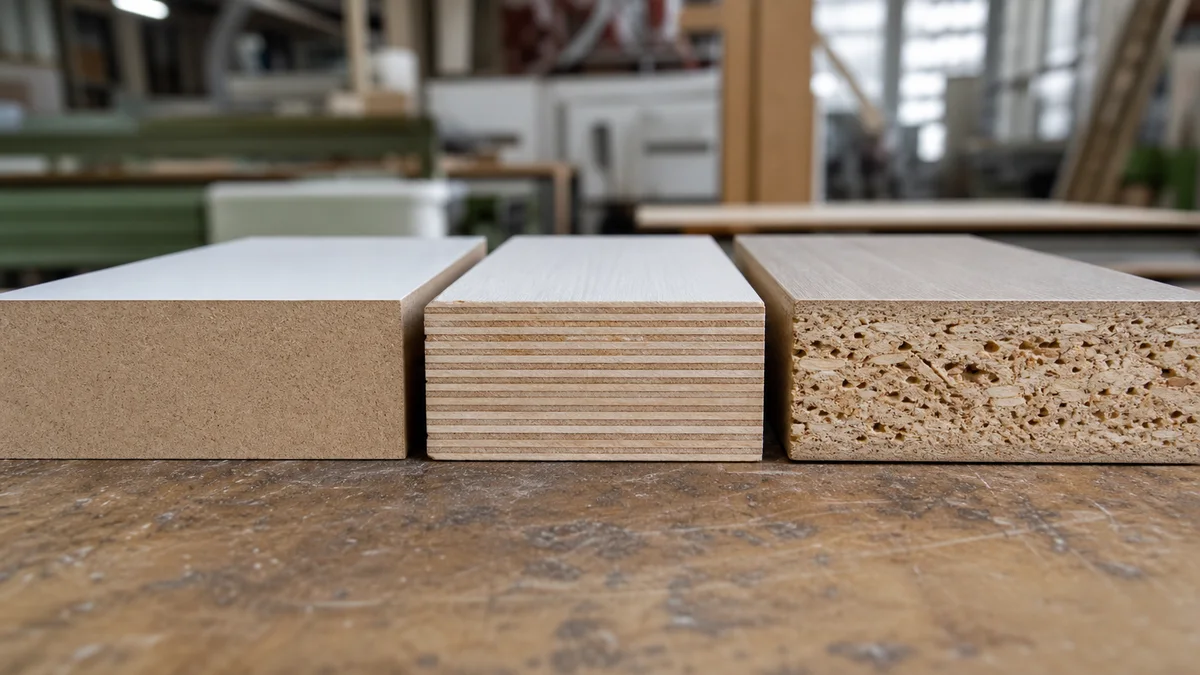
Buyers spend hours choosing door colours and thirty seconds choosing the carcass — yet the carcass is the cabinet. It carries the weight, holds the hinges, and decides how the kitchen copes with steam, spills and humidity for the next decade. The three candidates are particleboard, MDF and plywood, and the right answer depends on your climate, your budget and where in the cabinet each board goes. Here's the comparison, without the marketing gloss.
The three boards, briefly
Particleboard (chipboard) is wood chips bonded with resin under pressure, almost always sold melamine-faced for cabinet use. It's the global default carcass: dimensionally stable, flat, economical, and good at holding modern cam-and-dowel fittings. Its weakness is water — unprotected board swells if moisture reaches the core, which is why edge-banding quality matters so much.
MDF (medium-density fibreboard) is wood fibre pressed into a dense, perfectly uniform sheet. That uniformity gives it clean machined edges and a flawless base for sprayed finishes, which is why almost every lacquered door you've seen is MDF underneath. As a carcass it's heavier than particleboard and holds screws a little better; standard grades share particleboard's dislike of water, while moisture-resistant (MR, green-core) grades tolerate humid rooms considerably better.
Plywood is thin wood veneers glued in cross-laminated layers. It's the strongest and most water-tolerant of the three — it holds screws firmly, resists sagging on wide spans, and when moisture does get in it tends to swell less and recover better than fibre-based boards. It's also the most expensive and the least perfectly flat, which is why it's the premium choice rather than the default.
Strength, weight, moisture and cost
| Particleboard | MDF | Plywood | |
|---|---|---|---|
| Relative cost | $ | $$ | $$$ |
| Screw holding | Adequate | Good | Best |
| Sag resistance (shelves) | Fair | Good | Best |
| Moisture behaviour | Weakest; MR grades available | Standard weak; MR grades good | Best of the three |
| Weight | Moderate | Heaviest | Lighter than MDF |
| Surface for finishes | Melamine-faced | Best for spray/lacquer | Veneer or laminate |
| Typical role | Volume carcasses | Doors; MR carcasses | Premium/wet-area carcasses |
Read the table as roles, not rankings. In practice the industry's most common recipe is a melamine-faced particleboard or MR-MDF carcass with MDF doors in whatever finish the design calls for — a pairing we cover from the door side in our finish comparison guide. Plywood earns its premium where strength or moisture genuinely demand it.
The humid-climate question
If your project is in a coastal or tropical market — Southeast Asia, the Gulf, island markets, humid coastal cities — moisture resistance moves from footnote to headline. Steam, condensation and airborne humidity attack cabinets slowly, at the edges and joints first.
The practical hierarchy for humid climates: plywood first, moisture-resistant MDF or MR particleboard second, standard board only in dry interiors. Under sinks and in bathrooms, treat plywood (or at minimum MR board with sealed edges) as the specification, not the upgrade — it's exactly why our waterproof bathroom vanities are built on plywood carcasses as standard. In kitchens, many project buyers split the difference sensibly: plywood for the sink cabinet, MR board elsewhere.
Whatever board you choose, the detail that actually keeps water out is edge-banding and sealing — a well-banded MR particleboard cabinet will outlast a poorly banded plywood one. When your order is inspected, edges are the first thing to check; see inspect the carcass before shipment for the full checklist.
Matching board to project
Volume residential and rental projects in dry climates: melamine-faced particleboard carcasses. The economics are unbeatable at scale, and modern board with quality banding is genuinely durable in normal kitchen service.
Mid-range projects, humid climates, or clients who ask "what's inside?": MR-MDF or MR particleboard carcasses. A modest cost step for a meaningful durability step, and the green core is easy to show clients as proof of specification.
Premium projects, wet areas, heavy-use commercial kitchens: plywood carcasses. Strongest screw hold for heavy doors and drawers, best moisture behaviour, and a selling point in its own right — "plywood construction" carries weight with end buyers.
The three also mix within one order of custom kitchen cabinets: plywood sink units, MR board runs, standard board on tall dry storage. A factory building to specification rather than off the shelf can assign each board where it earns its cost.
One more specification line worth writing into your order: formaldehyde emission grade. Engineered boards are graded by how much formaldehyde they release — E1 is the common international standard, while E0 and near-zero grades sit above it and are increasingly demanded for residential projects, schools and hospitality work. The grade is a property of the board you specify, not of the board type, so ask for it in writing on the quote and confirm it on the incoming-material report. It costs little at order time and saves awkward conversations with environmentally-conscious end buyers later.
FAQ
Frequently asked questions
Is plywood always better than MDF or particleboard?
It's stronger and handles moisture best, but "better" depends on the job. For dry-climate volume projects, quality particleboard delivers almost all the performance at a fraction of the cost. Plywood is the right call for wet areas, humid markets and premium builds.
Which carcass is best for humid or coastal climates?
Plywood first, moisture-resistant MDF or particleboard second. Combine with sealed, well-applied edge-banding — the edges, not the board face, are where humidity gets in.
Why is MDF used for doors but less often for carcasses?
Its uniform surface machines and sprays perfectly, making it ideal for lacquered and profiled doors. As a carcass it's heavier than the alternatives and standard grades don't love water, so it's chosen there mainly in MR form.
Does particleboard mean a cheap cabinet?
No — it means an economical carcass, which is the industry standard worldwide. Quality shows in the board grade, the hardware and above all the edge-banding, not in the mere fact it's particleboard.
Can I specify different boards in one order?
Yes, and it's often the smartest spec: plywood where water lives, MR board in the rest of the kitchen, standard board in dry storage. A custom manufacturer prices each cabinet by its board.
Start a conversation
Tell us your climate and project type — we'll recommend the right carcass and send board samples
Get a Factory-Direct QuoteKeep reading
Related posts
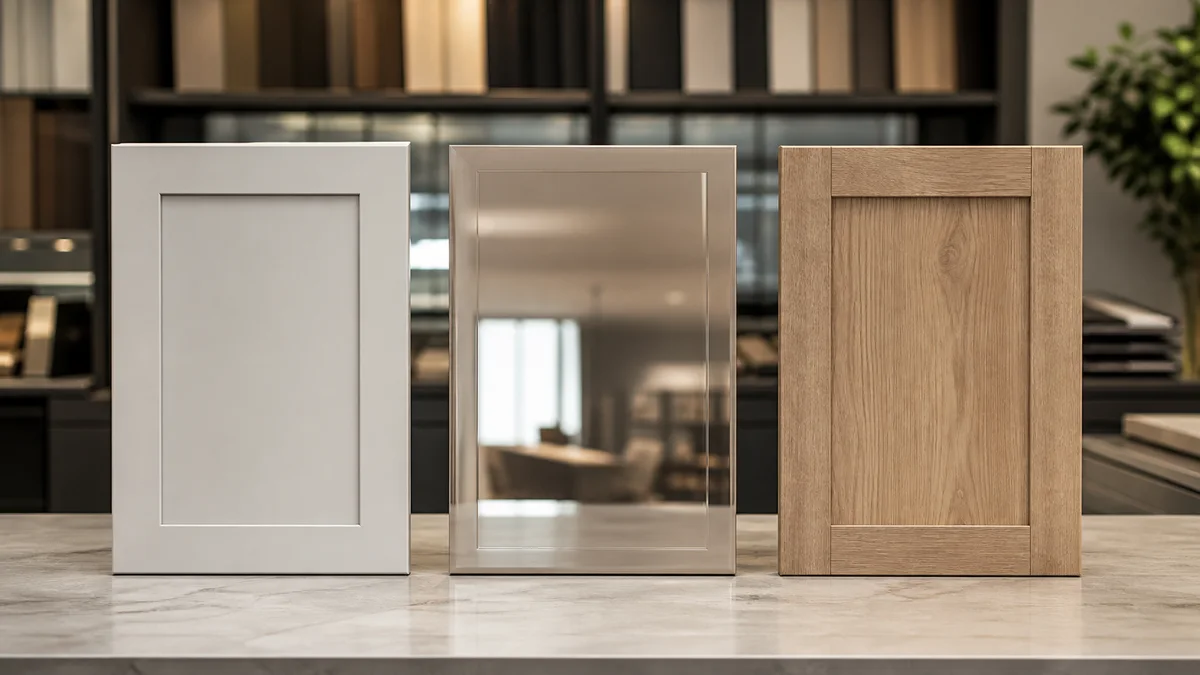
Lacquer vs Acrylic vs Melamine Kitchen Cabinets: Full Comparison (2026)
Lacquer, acrylic and melamine kitchen cabinets compared — look, durability, maintenance, cost and best use cases, to pick the right finish per project.

How to Inspect Cabinets Before Shipment (2026 QC Guide)
A pre-shipment inspection guide for cabinet buyers — what to check on carcass, doors, hardware, finish and packing, plus DIY, third-party and video QC.
Kitchen Cabinet MOQ, Lead Time & Pricing Explained (2026)
How cabinet MOQ, lead time and pricing actually work when buying from a China factory — what drives each, and practical ways to lower your landed cost.